

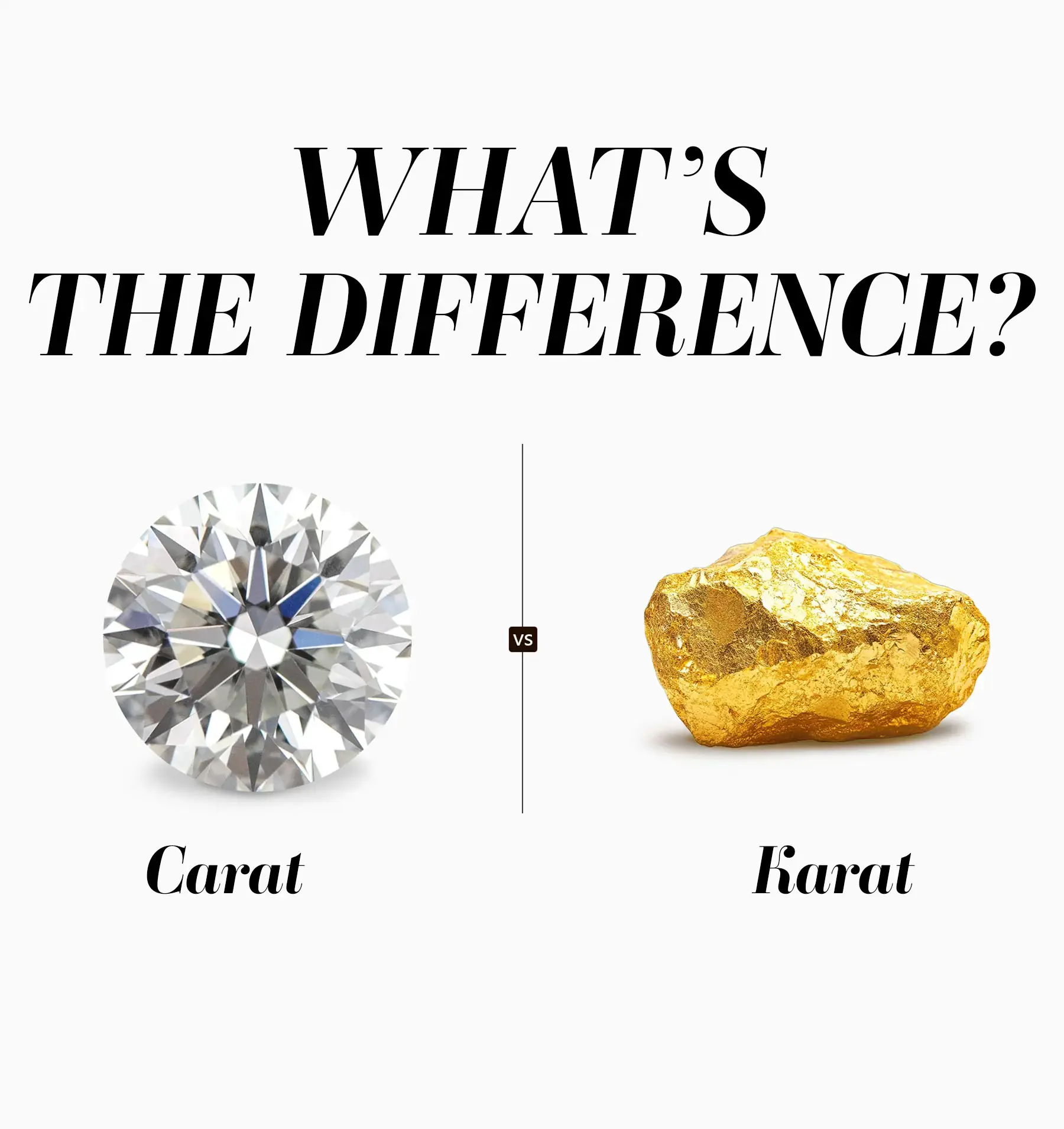
If you’ve heard the terms ‘Carat’ and ‘Karat’ in a jewellery store and wondered which is wrong, the answer is neither! They are both correct, but refer to very opposite commodities and qualities. Karat is for gold purity, while Carat is for diamond weight, making one qualitative and the other quantitative.
This blog takes novice jewellery buyers on a deep dive into jewellery terms, specifically, these two terms.
Are Carat and Karat the Same in Jewellery?
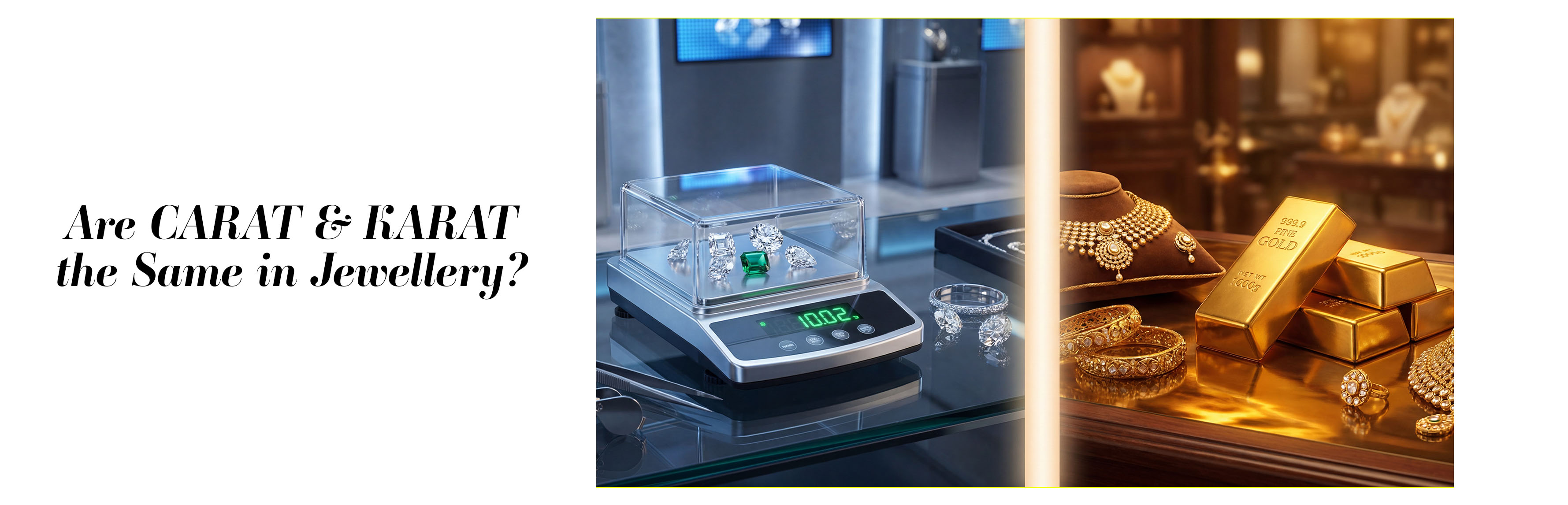
No. They are different! Karat and Carat both have uses in current jewellery terminology, but they refer to different things.
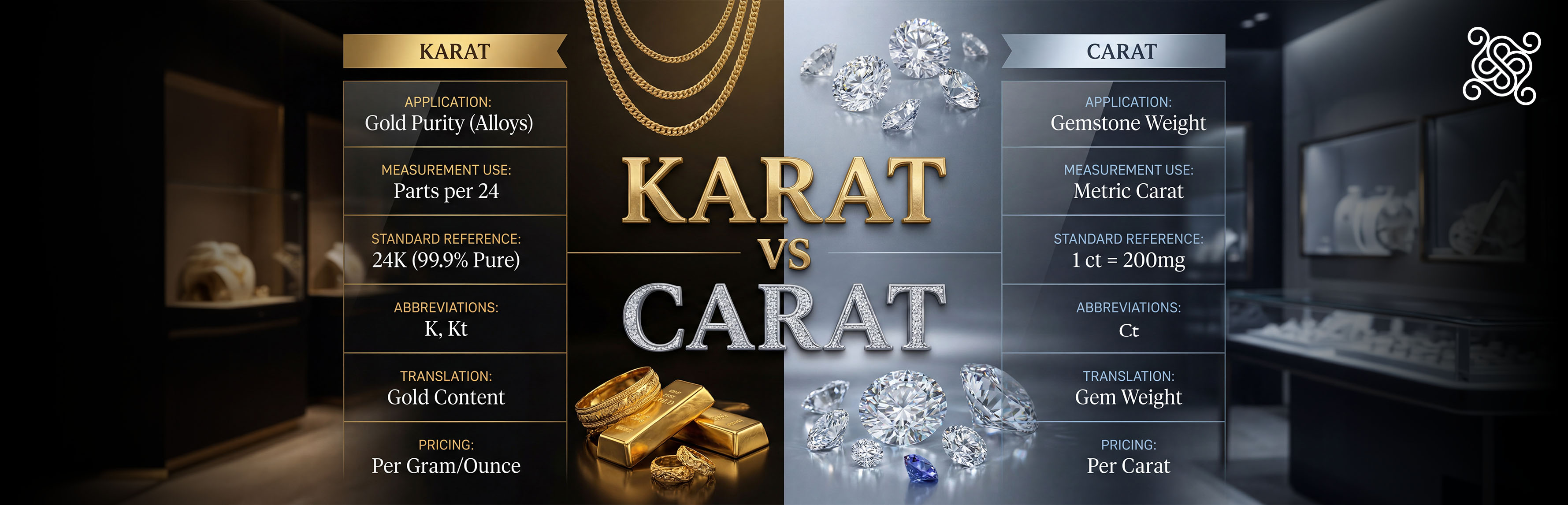
Carat or Ct explore the weight of diamonds.
Karat (K or Kt) measures the gold purity.
Anyone speaking about ct may not even be referring to gold, and anyone speaking about kt may not even be discussing diamonds!
Carat vs Karat: Comparison Table Based on Features
Why People Confuse Carat and Karat
Without seeing them on paper, anyone would think carat and karat are the exact same word. Look at them on paper, and you’ll see this isn’t quite the case!
What makes it worse is that they are spoken in the same manner, making further differentiation difficult, if not impossible!
You could tell them apart by understanding the context behind each unique word. Or, you could always ask the person to clarify which ‘carat/karat’ they are speaking about.
Confusion exists, as in older times, carat and karat were simultaneously used for describing gold purity. Today, 'carat' is only used for diamond mass.
What Does Carat Mean in Jewellery?
Carat in jewellery is an indication of a diamond’s weight and is used exclusively for diamonds and gemstones.
Ancient times witnessed ‘carat’ derived from ‘carob’ as the standard commodity used to weigh valuables.
A 1ct diamond has an approximate mass of 0.2 grams or 200 milligrams.
Diamond carat weight and diamond carat size are separate entities, both describing diamond quality in some way. The weight describes the stone mass, while the size details the diamond’s physical proportions.
What Does Karat Mean in Gold Jewellery?
With karats, it’s all about the purity of the gold and the alloy compositions if its purity is lower than 24K.
As gold purity increases, durability decreases, so a lower gold karat is desirable if you seek higher durability.
Gold purity peaks at 24K, while it is at its lowest in 9K jewellery, which happens to be the best for office or daily wear.
Silver, nickel, copper, and iron, aluminium, and titanium are other metals utilised in making gold alloys.
Which Matters More When Buying Jewellery?
Planning to buy a diamond necklace or a white gold pendant in time?
Pay closer attention to the gold karat if your focus is on gold. Inspect the diamond carat when you’re planning to buy jewellery solely for the diamond sparkle.
When a jewellery design looks more crowded by diamonds than it does gold, shift your attention to diamond carat.
If the design contains more gold than diamonds (or no diamonds), look at the gold karat, which mentions its purity and composition.
Best Gold Karat for Different Jewellery Types
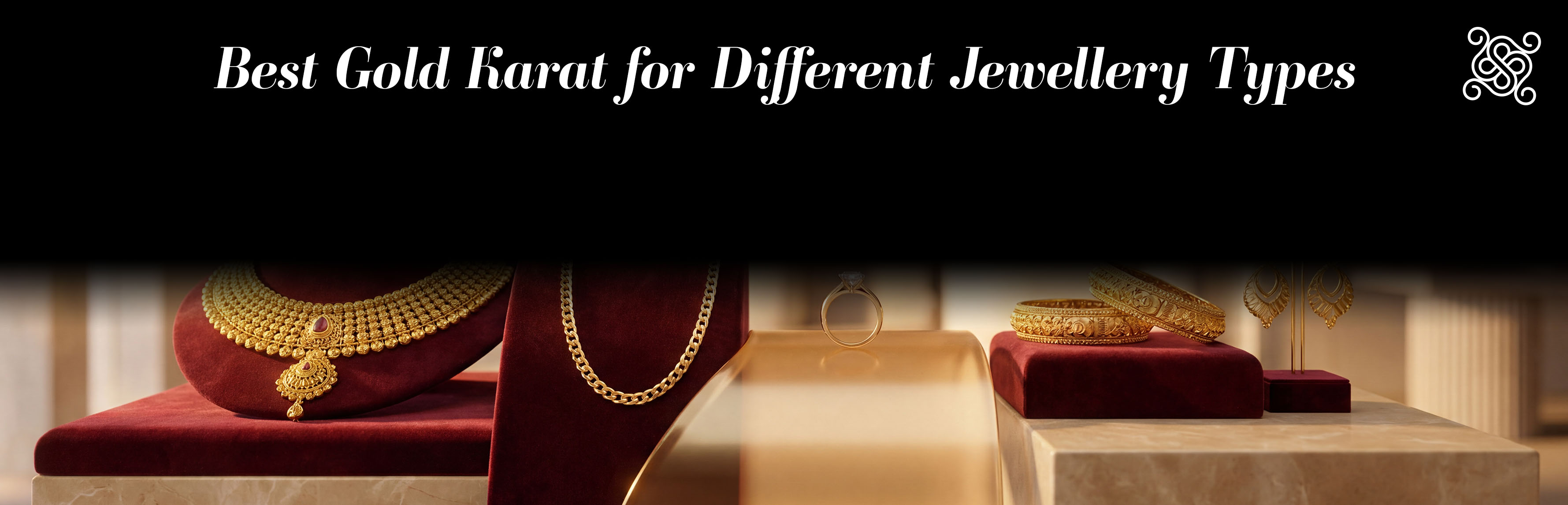
The same gold purity doesn’t always make the best pairing for every occasion. This makes it important to have a variety of jewellery made from varying gold purities.
Engagement Rings
Engagement rings fall under the banner of luxury jewellery and usually mix gold and diamonds to ensure they remain a worthy memory of a partnership between two people.
The best gold karats for engagement rings are 22 Karat and 18 Karat gold.
Office Wear
For office wear jewellery, which should be strong, appealing, professional, and not cost an immense amount, consider lower gold quality jewellery.
The best gold karat for office wear jewellery is 14 Karat gold.
Daily Wear
For jewellery that is meant to be worn the entire day, comfort is the only feature that matters the most! Apart from comfort, durability is another feature that gold jewellery should have if it is to be worn for 8+ hours and not get scratched or damaged.
The best gold karats for daily wear jewellery are 9 Karat and 14 Karat gold.
Bridal Jewellery
Such a ‘once-in-a-lifetime’ occasion deserves only the highest gold quality, and the attention should be on appeal and shine, and only one gold purity is capable of sustaining both requirements well.
The best gold karat for bridal jewellery is 22 Karat gold.
Vacation Jewellery
Summer vacation jewellery must have a fresh, light theme, and this is where both Kt and Ct come into use. Vacation jewellery comes with lab grown diamonds embedded into gold of a particular purity.
The best gold karats for vacation jewellery are 14 Karat and 18 Karat gold.
Mistakes Buyers Make When Understanding Carat and Karat
Anyone unfamiliar with jewellery terms and the do’s and don’ts of jewellery buying is most prone to make mistakes. Whether you wish to buy diamond or gold jewellery, this brief guide will prevent mistakes related to gold karat and diamond carat.
Mistakes with Diamond Carat
Mixing Up Size & Weight
Diamond carat weight refers only to the mass of the stone, and for some, surprisingly, has nothing to do with size! The dimensions of diamonds are known as their proportions and have nothing to do with carat.
Ignoring Smart Carat Compromises
There’s a standard diamond price per carat, and it increases sharply when milestones like 1 carat or 2 carat are reached. Selecting diamonds that fall under these milestone thresholds (e.g., 0.95, 1.90, etc.) slightly makes a massive difference to the final cost.
Putting Cut Ahead of Carat
Cut, another diamond-specific term, refers to the shape a diamond is crafted into, and many people choose to prioritise cut over diamond carat, a common misstep for novice jewellery buyers!
Mistakes with Gold Karat
Overlooking Wearability Needs
There’s no denying the influence of gold jewellery in India, and it shows as the country is the second-largest Asian market for this precious metal. Each gold purity appeals to a different group of people who have varying wearability needs.
Failing to Understand Hallmarking
Hallmarking differentiates gold-plated jewellery and solid gold jewellery, and a small engraving on the inner side of jewellery will appear as 18K, 14K, or 9K, but can appear as the three-digit alternatives, such as 750, 585, or 375.
Assuming 24K Works for Daily Wear
24K or 24 karat gold is an extremely pure category of gold, but comes with poor strength and durability as it is very soft and prone to scratches. This makes this gold purity a very bad option for office or daily wear jewellery.
Expert Tips Before Buying Diamond Jewellery
Getting the best karats and carats within your budget requires you to get smart and learn the best jewellery buying tips.
1. Learn the 4 Cs
The four ‘Cs’ are literally the all-inclusive guide you need to understand and buy diamonds based on quality.
Clarity: This parameter rates the diamond based on how ‘clean’ it is, and it can also be described as the absence of imperfections, known as inclusions.
Carat: You already know by now that diamond carat is an indication of the diamond’s mass and not a measurement of its size.
Colour: Colour can indicate the stone’s colour or a lack of colour in the stone.
Cut: When it comes to shape, the diamond shape is described as cut, and there are numerous diamond cuts.
2. Ask About Certification and Hallmarking
Jewellery made from precious stones and metals must have certification and hallmarking to certify their worth.
Metal Hallmarking
With the help of hallmarking engravings, you can certify the purity of the jewellery by seeing the small markings. The BIS hallmarks all gold in India, creating a brand of trust among all Indian jewellery buyers.
Grading Reports
Naturally, all jewellery that contains diamonds (mined or lab-grown) or solid gold (9 karat gold or higher) comes with a certificate of authenticity that states the diamond properties or gold purity.
Second Opinion
If you’re buying jewellery for investment purposes, you’ll want to ascertain the genuineness of your product by getting a second opinion.
3. Consider Maintenance and Storage
These gold or diamond jewellery items can be delicate, and cleaning care should be gentle enough not to break them!
You must store such jewellery pieces well to ensure their designs don’t get damaged or tangled, and ultimately lose their appeal. Store in a dry place in an air-tight box that’s made for storing jewellery.
End Note
Adequate knowledge about carat and karat is critical even if you plan to buy a simple modern pendant or luxurious eternity rings.
Using this knowledge, you’ll be able to pit value against cost to obtain a balance that makes you the winning side at the end of your jewellery shopping trip!
FAQs
Are carat and karat the same?
They couldn’t be more different! Carat refers to diamond weight, and karat refers to gold purity.
Is a 1 carat diamond equal to 1 gram?
No, a 1ct diamond is not equal to 1 gram; it weighs 0.2 grams, or 200 milligrams. Likewise, a 3ct diamond weighs 0.6 grams or 600 milligrams.
Is 24K gold best for jewellery?
24 karat gold is not ideal for jewellery making, as it’s too pure and too soft, making jewellery highly prone to scratches and damage.
What is carat in jewellery?
Carat refers to diamonds and is the unit of measurement for describing the stone’s mass.
Is it 24 karat or 24 carat?
If describing gold, it is 24 Karat, but if speaking about diamonds, it is 24 carat!
Can carat and karat be used to describe gold?
In the old days, it could, but not by today's standards!