

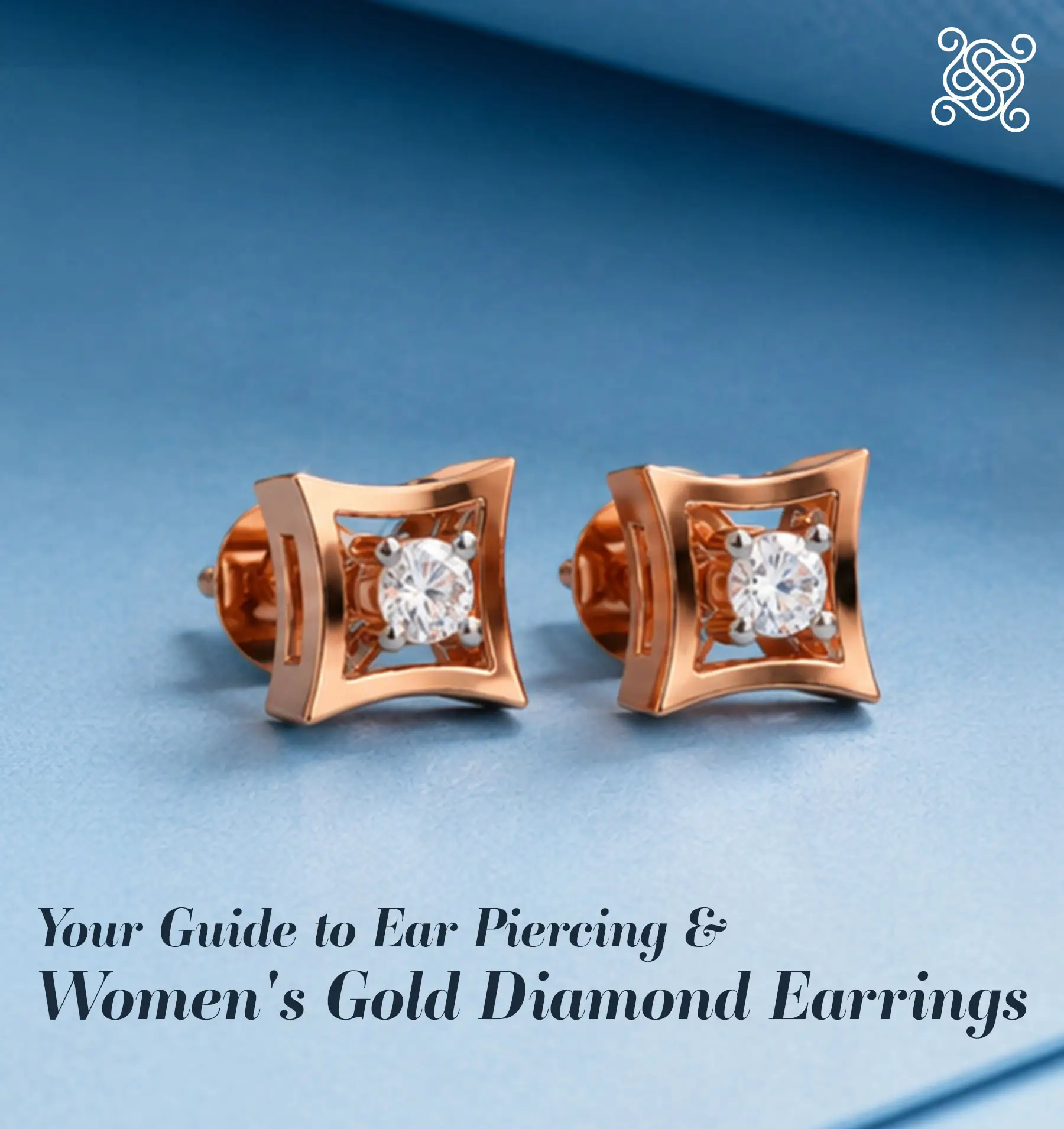
Piercing your ears has become as common as buying jewellery, making it important for jewellery brands to clearly and equally promote women’s earrings for all ear holes. The lower lobe piercing is the most renowned, with women getting them from childhood. All the other piercings, from the upper lobe piercing upwards, are not as widespread. When it comes to jewellery, diamond earrings, and particularly lab grown diamond earrings, are the first choice.
This blog serves as your ear piercing guide, educating you about the various piercings, their positions, healing times, and what type of lab grown diamond stud, hoop, or drop earrings are appropriate for each piercing.
What is Ear Piercing, Why Do People Do It?
Ear piercing refers to a globally practiced activity involving the voluntary creation of very small holes at various locations of the ear (inner or outer). Waiting for the hole to heal allows for the person to wear an assortment of decorative jewellery designs.
It’s a practice that has been ongoing for centuries, and is practiced by women and some men across cultures.
Although in older times, earrings were culturally symbolic, modern-day women’s earrings are about appeal and fashion.
Anatomy of the Ear
You can pierce your ear at multiple sites, but they don’t heal the same. This is because the ear is largely divided into portions based on its composition. Based on its form factor, ear piercings are split distinctively into two groups:
Soft tissue ear piercings
These are the parts of the ear that connect to the face, starting at the point where the ear joins the body. The main characteristic of this ear tissue is its blood vessels and several intact nerves.
Cartilage ear piercings
In comparison, these parts of the ear lack blood vessels and have fewer nerves. They appear at the extremities or outer portions of the ear.
The difference in their healing time and pain level makes it important to keep them as separate piercings. Also, within each group, there is a variety of ear-piercing types.
Soft Tissue Ear Piercings | Cartilage Ear Piercings |
Standard lobe & Upper lobe | Industrial, Helix, Conch, Daith, Tragus, Anti-Tragus
|
Types of Ear Piercing
When someone says that they are getting their ear pierced, you shouldn’t assume they are getting a standard earlobe piercing. But this isn’t the case nowadays, as there are several suitable positions for getting a piercing.
1. Standard Lobe Piercing
This is a common ear piercing for women and is the conventional piercing for all women.
Most women get this lower lobe piercing from a young age, ensuring the hole heals well and grows with age to comfortably accommodate a variety of earring types.
2. Upper Lobe Piercing
Positioned just above and slightly to the right of the standard lobe piercing’s position is the upper lobe piercing.
Most gold, silver, or diamond studs for women that are worn in the lower lobe can also be worn in this location.
3. Conch Piercing
Situated on the second inner cartilage lobe, conch piercings aren’t your traditional piercing! It’s a fashion statement piercing that isn’t as popular as some other popular types of ear piercings.
4. Industrial Piercing
The industrial piercing is usually a pair of piercings; one appearing in the top cartilage curve, and the other placed lower down on the outer cartilage curve.
The earrings for these earholes are usually long, straight earrings that sit in the ear at a descending angle.
5. Daith Piercing
Not to be mistaken with the tragus, the daith piercing sits above the tragus and is one of the portions connecting the inner and outer ear.
6. Tragus Piercing
This is the bit of skin-covered cartilage, sitting near the opening of the earlobe. Its position means that only certain types of earrings can fit in this piercing due to space.
7. Anti-tragus Piercing
This part is named so because it is positioned directly across from the tragus, and thus, "anti-tragus" also makes it easy to remember. It’s also not a conventional type of piercing that most women and men get.
8. Helix Piercing
The position of the helix piercing is easy to remember because it sits between the two industrial ear piercings, which because it sits on the top outer lobe.
Ear Piercing Healing Time
Because the parts of the ear don’t have the same access to blood and number of nerves, there is a stark contrast between the healing time of ear piercings. Here’s a table that comprehensively shows the approximate piercing healing times by location.
Ways to Pierce Ears Safely
Ear piercing is practised everywhere, on every continent, in every country, and in every city, underscoring the huge demand for this practice. When it comes to getting an ear pierced, these are your options:
1. Ear Piercing Using a Piercing Gun
A globally recognised standard for ear piercing, particularly the upper or lower (standard), is to use a piercing gun. However, a limitation of this method is that it is dangerous and ineffective for cartilage piercing.
Dermatologist & Cosmetic Experts
Usually, getting a piercing from a dermatologist or cosmetic expert is considered the safest option. The tools used to make the piercing are guaranteed to be sterile and free of infectious agents which affect healing time.
Tattoo Studio
Not the most ideal place to get a piercing, but it remains an option. There is usually speculation about the cleanliness of tattoo studio practices, especially about the needles used while piercing.
Jewellery Shops
Since jewellery stores sell jewellery, including women’s and men’s studs, they may offer ear piercing services as well. These stores usually keep an ear-piercing kit that includes a piercing gun.
Ear Piercing Using a Sterilised Needle
This is an option that is more accessible in India. These single-use needles are long, thin, and hollow, allowing for more accurate angle and depth perception.
This method is also preferred for its limited tissue damage, meaning a relatively speedy recovery when it comes to piercing any part of the ear.
Standard lobe piercing is also possible using this method, but be warned, it may be more painful than when using a gun. There are no restrictions with the method, and all parts of the ear can be pierced using it.
Local Jewellery Stores
The traditional women’s jewellery sellers at local bazars are known to opt for the more traditional method of ear piercing for women. These places offer a quick piercing and even quicker healing.
Ear Piercing Aftercare Tips
You can’t discuss any type of ear piercing without covering aftercare and healing. Extra care and routine cleaning will ensure your earholes don’t become infected and heal quickly.
Clean the earholes thoroughly with saline and cotton pads at least twice a day.
Don’t touch your earholes, and if you do plan on touching them, sanitise your hands properly.
Don’t wear any jewellery until the ear hole has healed properly.
Avoid swimming in lakes, beaches, and swimming pools until healing is complete, as it could introduce bacteria.
Only use saline and stay away from harsh antiseptic materials unless specifically recommended by a doctor or expert.
For the first few weeks, don’t sleep on the fresh piercing as it can irritate the piercing and slow healing.
Be cautious about what earrings you use after healing, as you may be sensitive to certain metals.
Best Women’s Diamond Earrings Based on Piercing
Because of their positioning, each type of diamond earrings suits a specific ear piercing. Given the properties, cost, and availability, lab grown diamond earrings have been the leading option for women with multiple earholes.
Women’s Earrings for Standard Lobe Piercing
The standard lobe features the most conventional position, making it easy to wear just about every type of earrings. Because the lobe is rather thick, there’s room to try designs that require depth.
One design that comes to mind is diamond stud earrings, which feature a long ‘post’ that joins to the back stud. This goes through the long channel created when getting a lower lobe piercing, and the diamond shapes can vary.
If you want to be fancier, diamond open hoop/huggie earrings are the way to go, thanks to their suspended form factor. They are fixed with a post at the lower lobe earhole. They mix 14 karat gold with round cut diamonds to create a hoop earring design worth saving up for.
The flashiest type of earrings for women is diamond drop earrings, which make use of the fact that the earrings can hang down from the ear. A design under this category is the spiral drop earring, featuring an equal blend of yellow gold and round diamonds.
Women’s Earrings for Lower Lobe Piercing
Located quite close to the standard or lower lobe piercing, this particular piercing enjoys the same qualities as the others. Similar earrings can be worn in this earhole that sits in the same soft tissue region.
Diamond stud earrings for women are appealing, accessible, and pair well with all clothing. They can have a single princess cut diamond, a heart-shaped diamond, or a simple round-cut diamond. Besides selecting a pair based on diamond shape, you can also choose a specific shape of earring, like a heart or star shape.
Because of the close proximity to the lower lobe earhole, the earrings worn in this earhole are called huggies because they cling or rather ‘hug’, the earlobe. These diamond huggies feature a rose gold finish and ‘Mother of Pearl’, making it a head-turning accessory.
Women’s Earrings for Conch Piercing
The conch sort of acts as a joining element, connecting the ‘fleshy’ parts of the ear with the cartilage parts. For a conch piercing, loose-fitting hoop earrings are ideal for women to maximise the appeal of this earhole.
The best diamond hoop earrings for this earhole are those that are quite wide and feature a textured diamond look. A diamond pavé features a paved look that uses diamonds with the same shape and size, but gives the accessory volume.
Women’s Earrings for Industrial Piercing
Although most industrial piercing earrings may appear as a long arrow, breaching both ear holes, other earrings also suit this position.
Simple and solid micro studs are a favourite for minimalistic working women or students seeking comfortable daily wear earrings. This 9Kt jewellery is making an impact with its ability to merge gold metal and lab grown diamonds at serve it at a price point that appeals to all!
Coloured lab grown diamond studs featuring the ‘Toi et Moi’ design and cluster stud earrings are a fan favourite when it comes to earrings for industrial ear piercings. You can also choose to play it safe with a solid metal and solitaire diamond cut (shapes) stud design.
Women’s Earrings for Daith Piercing
The daith rests in the innermost fold of the ear, appearing slightly tricky to accessorise. However, most jewellery stores do well to make delicate and specific jewellery for this ear hole.
Appealing, small lab grown diamonds hoop earrings are chosen because of their intricate form, which fits the limited space of daith piercings. Tiny pinhole studs are, in some instances, the only earring that will fit in these earholes.
Women’s Earrings for Helix Piercing
The helix earhole sits between the two industrial piercings, or on the curve of the top-most, outer earhole.
As with other ear piercings, this one does have some restrictions. Drops and delicate drops are out of the question, leaving very small, fitting huggies (hoops) and studs as the options.
These can be very thin hoops or very intricate studs which feature a low carat (weight) value.
Why Choose Lab Grown Diamond Earrings?
Women’s diamond earrings have existed for as long as diamonds have, and they are a jewellery item present in every woman’s home. Though this constant has remained, the type of diamonds has changed.
The success of lab grown diamonds is steadily expanding daily as these manufactured diamonds become more accessible due to their cost-efficient and speedy production process.
The processes used to manufacture diamonds may be energy-intensive, but they are sustainable, ethical, and don’t leave land unappealing and unusable.
You get just about every cut or shape of diamonds, and when coupled with 9 karat gold, you get a pair of earrings that are made to stun the crowd but be durable enough for daily wear.
Trending Lab Grown Diamond Stud Earrings
Stud earrings are typically the first type of earrings a woman wears, as they are the staple for young girls and children who’ve just pierced their ears. Simple or diamond-studded, these stud earrings are a permanent fixture in every woman’s jewellery box.
Trending Lab Grown Diamond Drop Earrings
Drop earrings are appropriate for special events or professional settings where bold earrings that aren’t too attention-seeking are most appropriate. These can feature different shapes, making them a diverse option.
Trending Lab Grown Diamond Hoop Earrings
Hoop earrings present an inspirational jewellery story, showing how retro designs can make a successful comeback. They’ve evolved and can feature round diamonds, dual-tone metal finishes, or incorporate other coloured lab grown diamonds.
End Note
Getting ear piercings is fun, but then comes the part where you plan and pick out earrings for each ear. There’s no universal one-size-fits-all earhole, because each one has a story and character which only certain types of earrings suit.
Svaraa is an expert in women’s earrings and deals especially in various lab grown diamond earrings that can be worn in various ear holes.
FAQs
What are the 7 ear piercing types?
There are several types of ear piercings, and the seven most common ones are upper lobe, standard lobe, helix, industrial, conch, daith, tragus, and anti-tragus piercings.
Do ear piercings hurt?
Yes, but cartilage piercings don’t hurt as much as the lower soft tissue piercings.
Do lab grown diamond earrings look just like mined diamond earrings?
Chemically and visually, they are clones; the core differences are their sources and costs.
Which is safer, getting an ear piercing with a needle or a piercing gun?
Needle piercing is best for cartilage piercings. That’s because piercing guns can damage the tissue and leave permanent disfigurement.
Can I swim after getting ear piercings?
Going swimming after getting piercings isn’t advised, as piercings are prone to infection, and swimming could introduce bacteria to the piercing site.
What is the safest type of earrings to wear after getting ear piercings?
Diamond studs are the safest type of earrings if you’ve just gotten your ears pierced, and you should stick to pure metals, such as titanium, silver, and gold.
In which ear holes can I wear hoop earrings?
Hoop earrings can be worn in Helix, Conch, Upper, and Standard ear lobe piercin